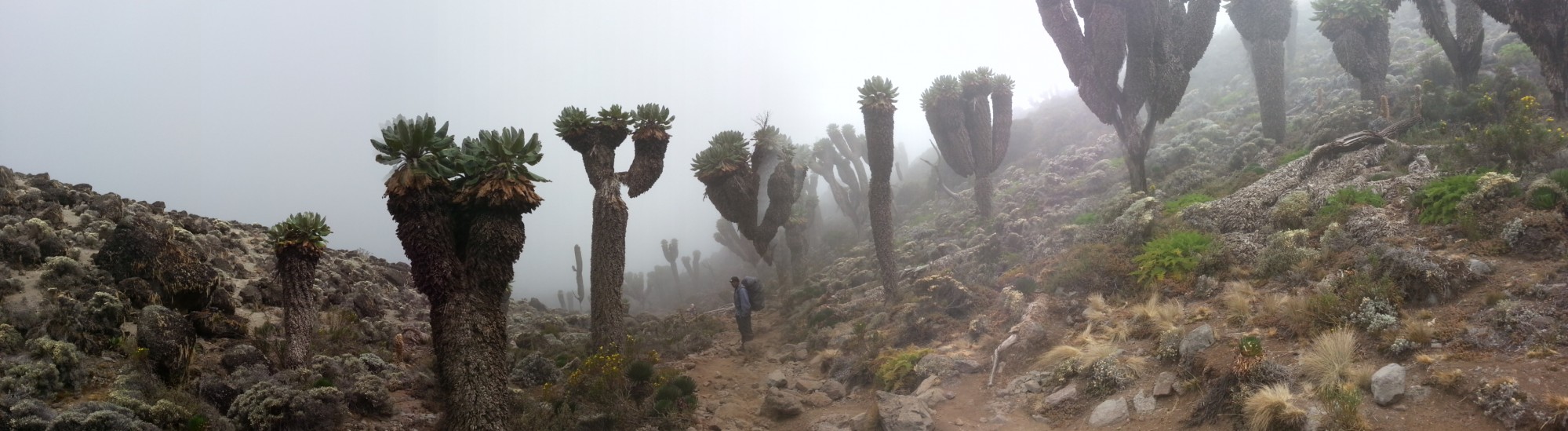
IMPORTANT! Click on any of the pictures below to go to the full photo/video album for Day 8. We highly recommend clicking on the “show info” button at the top right of the album page if you’d like to see our description of each picture. Also when videos play, be sure that the HD box on the bottom right is lit, or the video will look terrible!
(Note: If you are clicking through the pictures manually, be aware that there is a Flickr bug that causes a video to play if you’re looking at the picture preceding the video). We apologize for the inconvenience, but you can mute the audio if it gets annoying.
This blog page has pictures mixed in with the text, for a more immersive, interactive & intense experience.
As we set out from camp at midnight, we’re feeling pretty good. We’re marching single file up the mountain, and only a few of us have our headlamps turned on.

The moon is near full and is easily bright enough to navigate with. In fact none of the guides are using lights. Temps are low, but there’s hardly any wind on this first leg of the climb so despite being 30 degrees, we hardly feel it. In fact this is perfect weather for exertion. The bright moon makes it easy to navigate, but unfortunately it kills the view of the stars. As we continue up the mountain we see a few lights ahead of us, and many lights behind us; it looks like we’re one of the earlier groups out of camp. This was by design. We want to allow ample time for this climb so that we don’t get hit with altitude sickness. After all, we’re doing this without any kind of medication so we don’t want to take any chances. We’ve slowed down considerably from our already slow(pole pole!) pace with our big backpacks. Despite carrying our light day packs, we must be going 0.25-0.5 mph up the mountain. Even so, we’re faster than most of the other groups.
We’ve now been hiking for three hours, and we arrive at the top of a subsidiary peak when the wind hits us. It’s not too strong, maybe 20 mph but the windchill brings the effective temperature down to about 10 deg F. This is honestly still not bad if you’re moving. The problem is, even at the slow pace we’re going at, you get exhausted every now & then so breaks are necessary. When you stop for a break, you immediately freeze. We try to limit the breaks to a minute or two, because our bodies start to shiver as soon as we stop. Climbing this mountain is a dance between overexertion & hypothermia.
It’s been about four hours since we left camp. Temp’s probably 0 degrees F now with windchill and the altitude is really starting to get to us. We’re at around 17,000 feet, and our sense of balance continues to get worse & worse due to the lack of oxygen. It’s still not bad, we can more or less follow a straight line, but every now & then we’ll veer off course & have to correct our balance. We have to remember to continuously overbreathe, because a cough or a sneeze means one breath that’s not going to our bodies. Missing even one breath means getting dizzy or lightheaded. It’s becoming harder to think clearly. We keep running mental math exercises in our head, but even that takes significant effort.
It’s been five hours and we just arrived at Stella Point, which is on the crater rim. From here it’s another 45 minutes to Uhuru Peak, but the situation has rapidly deteriorated. We are assaulted with brutally cold wind the instant we reach the exposed Stella Point. I think the mountainside was shielding us from the wind until now. We estimate the wind is 30-40 mph, and effective temperature is down to probably -20 deg F or less but honestly it’s hard to tell as we aren’t thinking very clearly. We quickly don our balaclavas, ski goggles, and every layer of technical cold weather gear that we brought with us. We then realize that this isn’t enough. The only way we’re going to avoid getting hypothermic is by continuing to exert ourselves. So we continue climbing.
It was around here that both of our camelbaks tubes’ froze, despite being insulated in 1/2” thick neoprene rubber. This is very bad, as staying hydrated is paramount on a mountain. Staying hydrated allows your body to oxygenate efficiently, getting red blood cells to the parts of your body that need oxygen; a scarce commodity at elevation. Oxygen deprivation leads to issues like nausea & vomiting, not to mention cerebral & pulmonary edema. Under normal circumstances we would bend the tube, trying to break the ice within to free the line but we are in no state of mind to think of such things. We vaguely register that our water bladders have frozen, and continue to climb to the peak. There is absolutely no view, since we are climbing at night, and clouds have rolled in below us, blocking any view below.
After what we were told was 45 minutes, we make it to Uhuru Peak. At this point all sense of balance is gone. We are stumbling up the mountain like drunks. Even our guide Faustin is a little unstable, though his steps are not nearly as bad as ours. Thanks to Faustin & Richard, we are able to cut in front of the line in front of the Uhuru Peak billboard and have our picture taken.

We proceed to get the hell off the mountain as fast as humanly possible. At least this is what I do, as trying to conserve weight, I didn’t bring a midlayer on this trip. A base layer & an outer shell is not nearly enough to withstand this kind of weather, so I sprint down to the mountain to get below Stella Point, which is shielded from the wind. Rushi, more insulated with his Mountain Hardwear down midlayer & Arc’teryx outer shell, and whose knees have issues with downhill slopes, proceeds at a slower pace down the mountain.
Dawn breaks as we descend the mountain, giving us amazing views of the glacier & the world below.

Too bad the only thing we’re thinking is how to get out of this brutal windchill. Taking pictures & videos are the last thing we want to do right now, but Rushi manages to get a few pictures on the way down.


We apologize for the lack of pictures during this part of the climb but trust us, if you were there, you would have done the same.
For most of the way down to camp we slide on loose gravel, almost surfing the rocks & pebbles down. We are able to descend rapidly this way but it is killer on our knees, which are swollen by the time we get to camp.

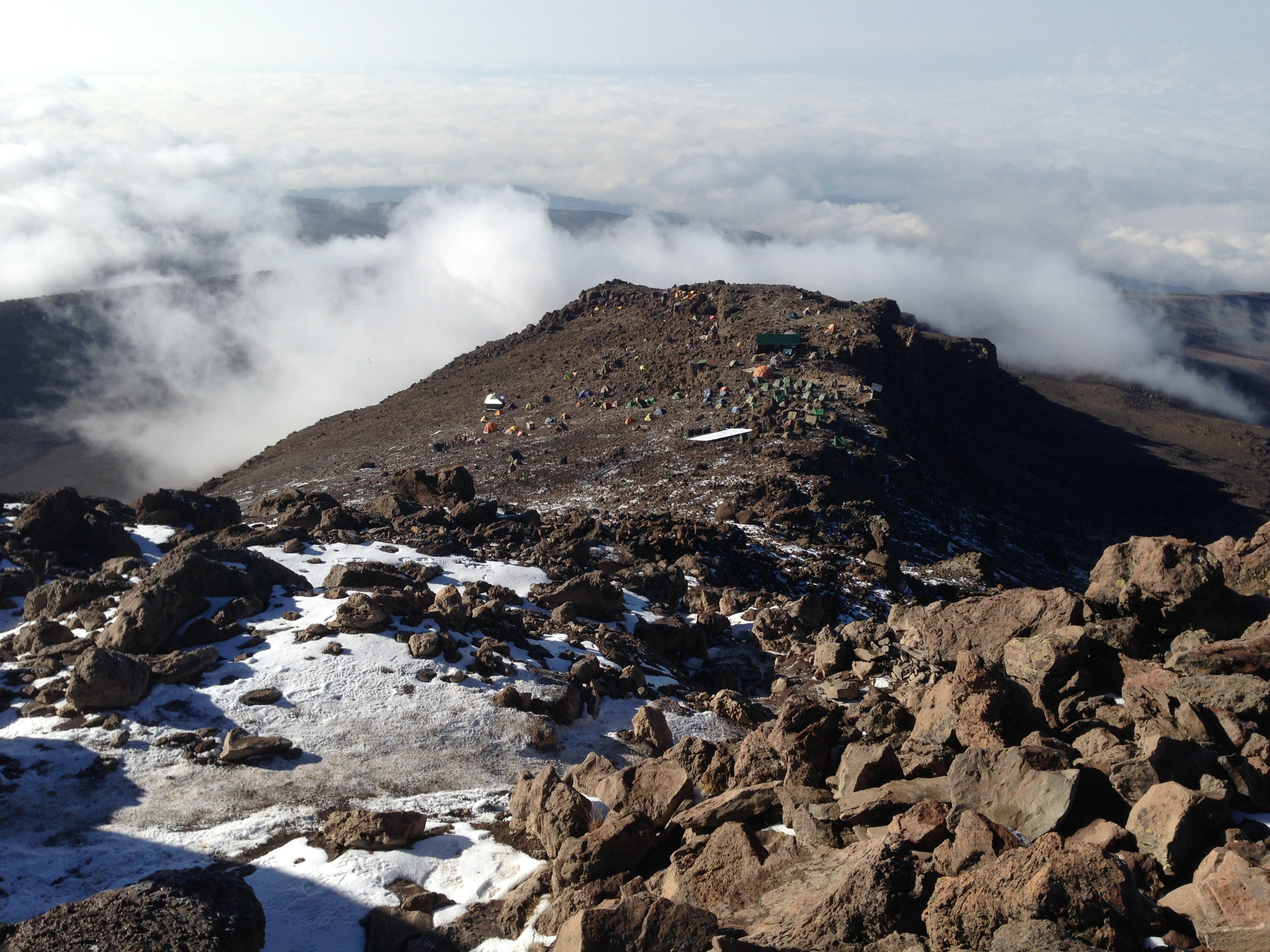

Unfortunately this was not the end of our day. After getting back to camp and drinking some of the most delicious fresh squeezed orange juice prepared for us by the porters, we rested for an hour before packing up camp & heading out to Mweka Camp, another 5000 ft(1524 m) below us. The descent was again brutal on the knees, though we made good time and got to the camp by 2:10. We had dinner & then got what was the best night’s sleep on the entire trip. To the victors go the good night’s rest.
 Planetary Muffin Expeditions