“I got sicky sick nar nar pow pow up to my nip nips!” — A Snowboarder
Click here to go to the photo/video album for this day
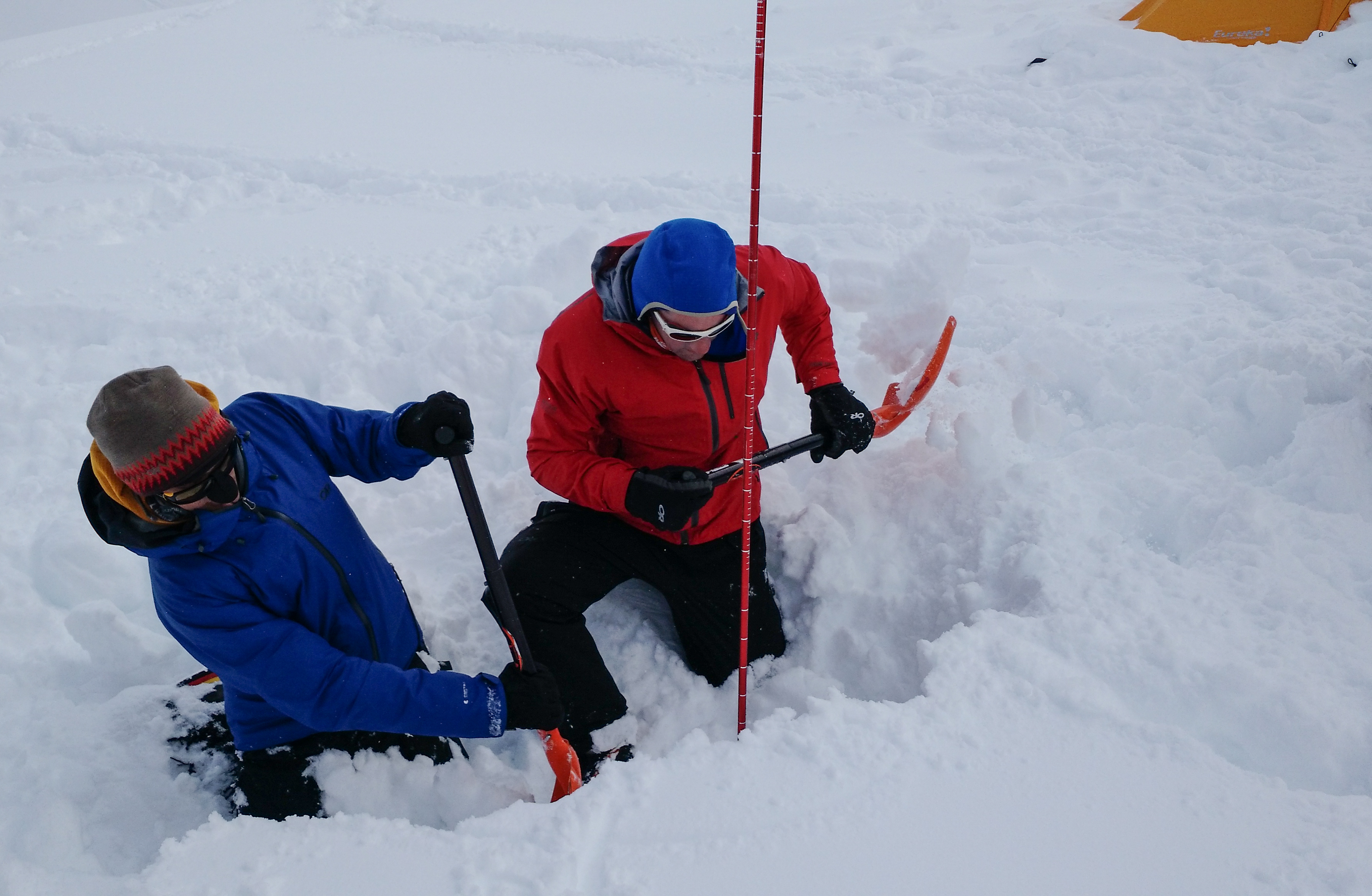
Today was an exciting day(every day on a mountain is exciting!) We learned about how an avalanche rescue process works, and then buried the team member we disliked the most, to practice… we just buried sleds & snowshoes, but that would have been fun too! We started the morning with a delicious hot breakfast in the cook tent followed by a lecture on the procedure from Chris.
A typical avalanche rescue goes something like this:
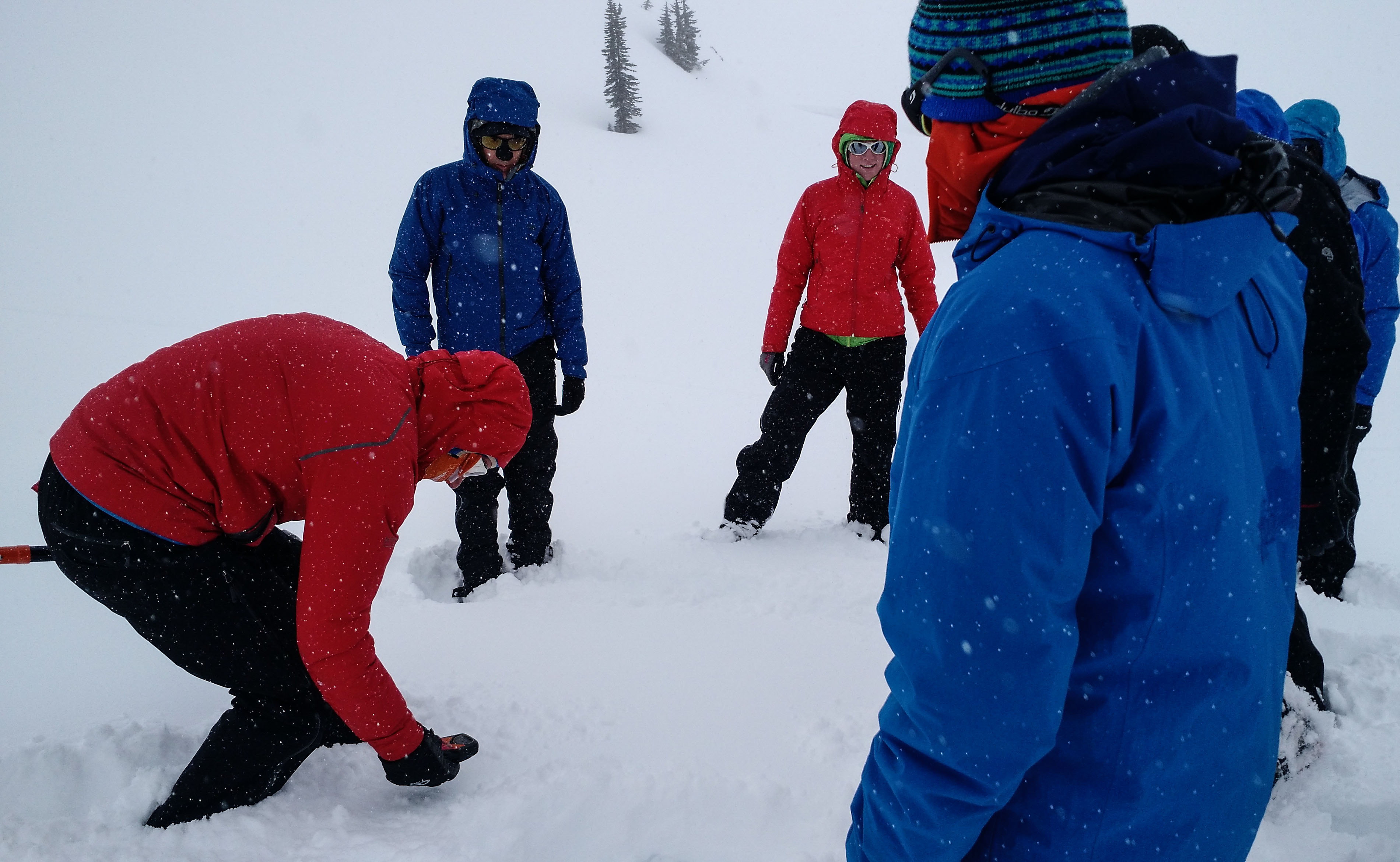 There are three main parts to an Avy rescue. First is finding the person, which is done by traversing a grid using our own Avy beacons in search mode, trying to find the buried person’s own beacon. When in avalanche terrain everyone is required to wear a beacon on them at all times(it’s pretty bulky & uncomfortable). It’s continuously broadcasting its signal, which allows rescuers to find the buried climber.
It turns out coordinating a grid search between team members is harder than it looks. From initial burial to dig-out, rescuers have a 15 minute window after which survival rates begin to plummet due to asphyxiation. Once the signal is found, the rescuer attempts to get as accurate of a location as possible by getting down to the snow & monitoring the distance indicator, boxing a region which has the smallest distance readings.
Once a box has been set, an avalanche probe(a 3-meter long telescoping pole) is repeatedly inserted into the snow at different locations in a circular or spiral pattern to try to get the exact location of the climber. Once found with the probe, the real fun begins. The rescuers shovel as fast as humanly possible to dig the person out, but even the digging is structured. Digging straight down is of little benefit. Even if found, it’d be impossible to pull the person out, so rescuers must dig the person out from the side, creating a large hole, while maintaining a shallow enough slope so that they don’t dig themselves too deep to shovel effectively.
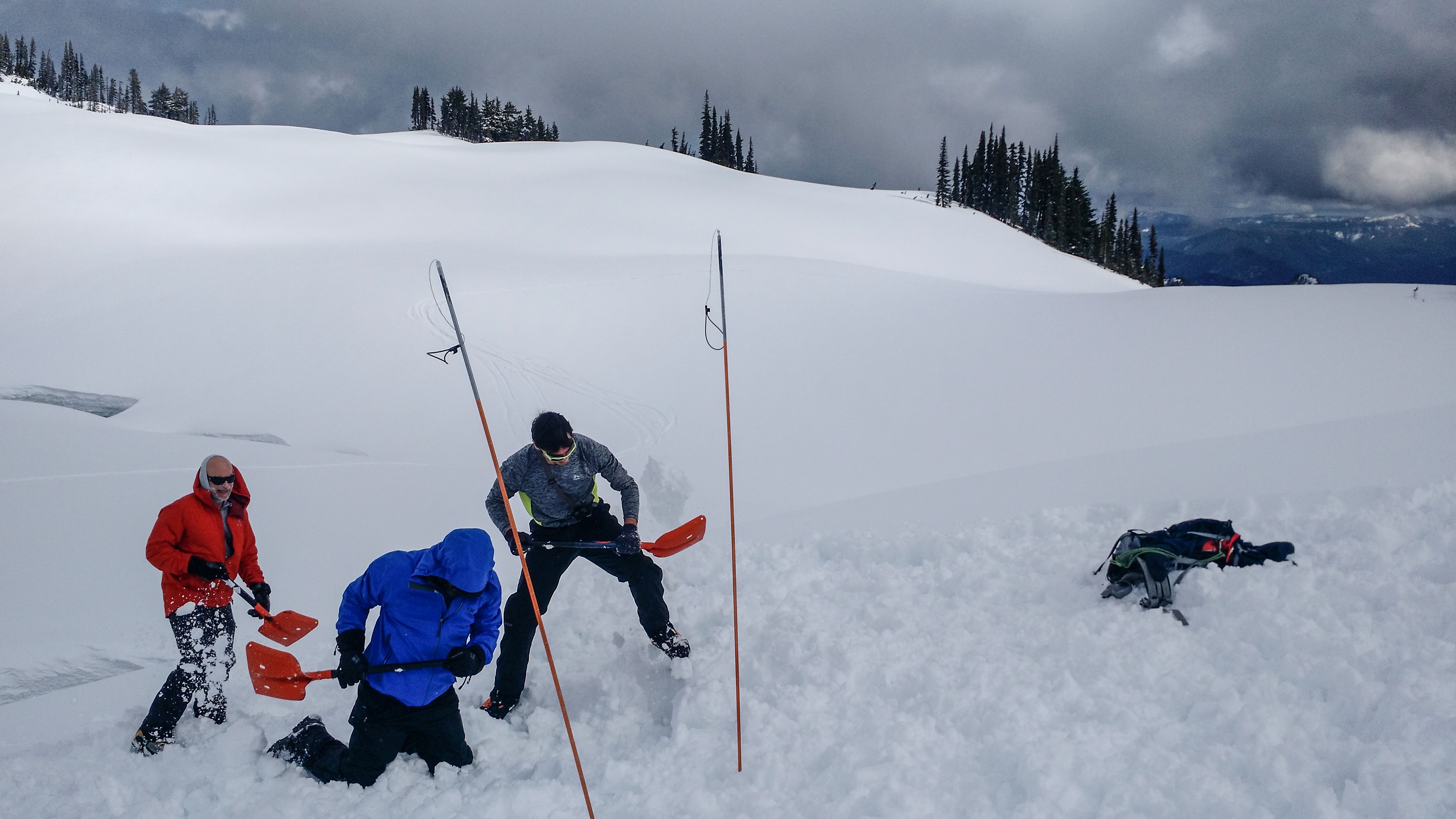
We broke off into two teams of three(Team Skittles & Team Smurf for the color of clothing we happened to be wearing), and practiced using our avy beacons to box out an approximate location. We then practiced using the probe, followed by an intense side-by-side digging competition between Team Skittles & Team Smurf to see who could get the buried beacon out faster(it was a draw). We finally put it all together in a timed run of the entire process.
We ended up going first. The guides buried an avy beacon at a location unknown to us and we were told the approximate size of the imaginary avalanche. The team was Rushi, Ann & myself, and Rushi ended up picking up the buried signal first. As Rushi proceeded to box the approximate location of the beacon, Ann and I sprinted to his location(running in deep powder is pretty hard work, it turns out – it’s more like fast stumbling). I took off my pack & assembled the Avy probe while Ann got out & extended the shovels. I then began probing & got a positive location after about 8 or 9 tries. We then started our dig, which went off pretty well. Thoroughly soaked in sweat by the end, we managed to reach the buried beacon after a total run time of 13 minutes.
Team Smurf(Carlo, Richard & Roberto) went next. However, having had the benefit of seeing our run, they managed to complete their rescue in 7 minutes. Given the handicap, we figure we’ll call it a draw! After each run, we discussed the things we did well & things we could improve upon, so the simulation was of maximum benefit.
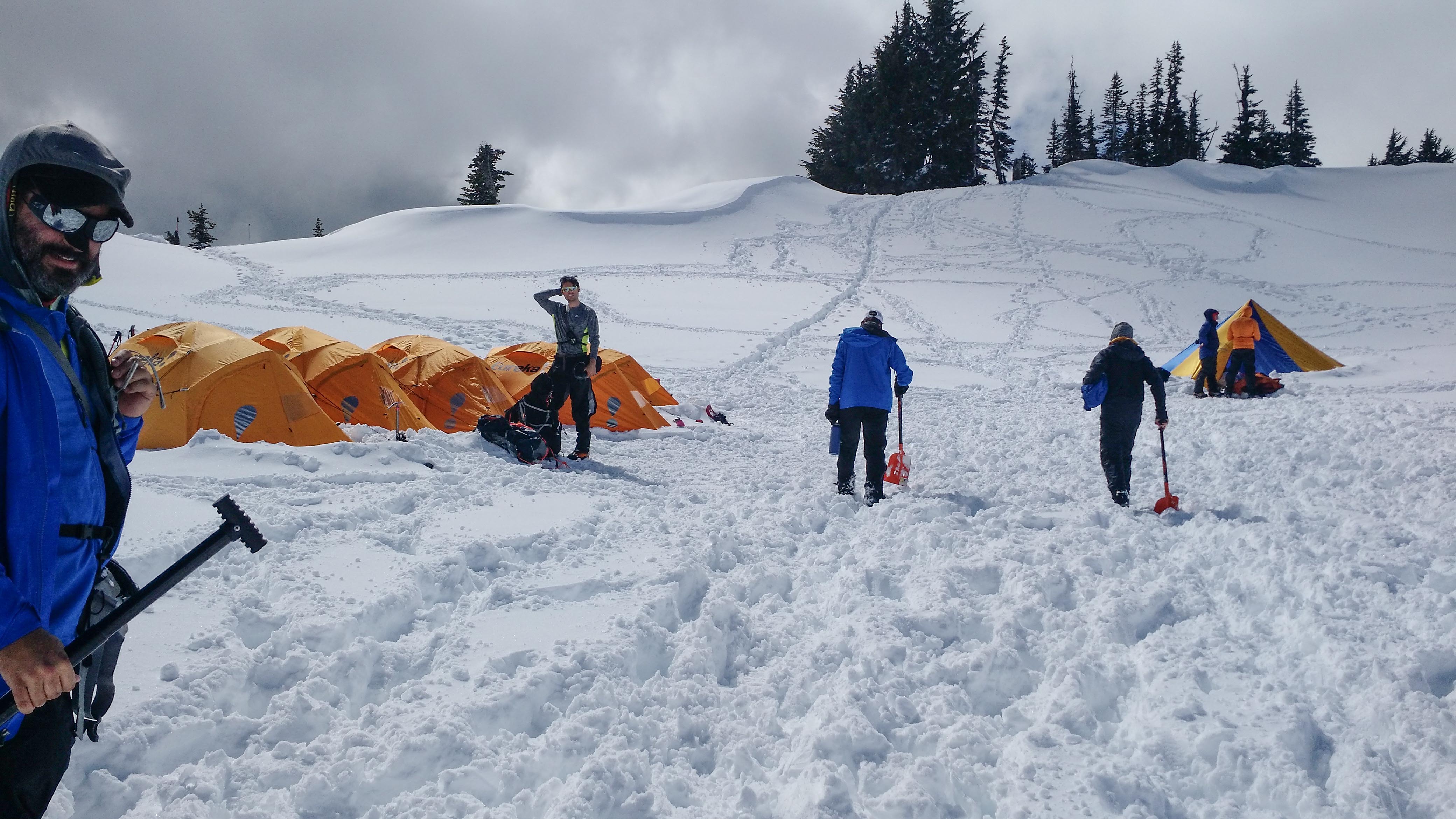 After taking a short break, Jonathan taught us techniques for walking in deep snow up steep mountains – the cross step, the duck step & the rest step, as well as how to hold & walk with our ice axes. After practicing on a hill near camp for awhile, we got the hang of things. On the way down we learned how to bound step quickly down steep powder slopes.
Next up was Betsy who taught us the important skill of Self-Arrest – the process of stopping your(or a roped teammates’) fall down a steep snow slope. It basically involves slamming your ice axe into the snow, throwing all of your weight on it & then kicking as furiously as possible with your shoes(which would normally have crampons attached) into the mountain to create a deep footing on which you can stand, bringing you to a stop or bracing a fallen teammate’s weight. The thing is, you can fall on your back, face up or face down, or on your stomach pointed uphill or downhill. So we practiced all the permutations(in-place – unfortunately the slopes had too much powder to let us actually fall down).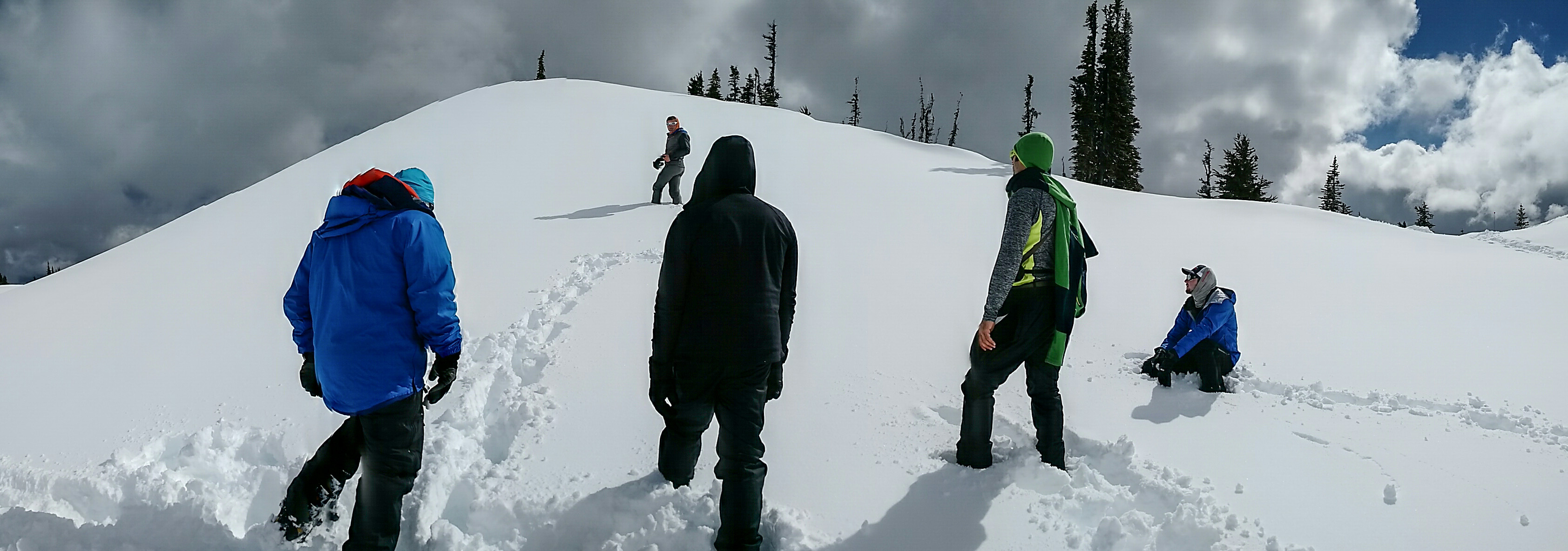
Finally we learned the Alpine butterfly knot & learned how to walk in a rope team – 3 people tied to each other by a length of rope, so if one person should fall down the mountain or into a crevasse, the other two can rescue them. Turns out it’s not natural, as you have to match your pace exactly with the person in front and/or behind you to keep the slack in the rope consistent. Switchbacks and turns also require special handling, so it takes some getting used to. I think that familiarity with your rope team members’ gaits would make this much easier.
After this long day, we had another awesome hot dinner in the cook tent, talked about tomorrow’s push to Camp 2 and hit the sack!

 Planetary Muffin Expeditions